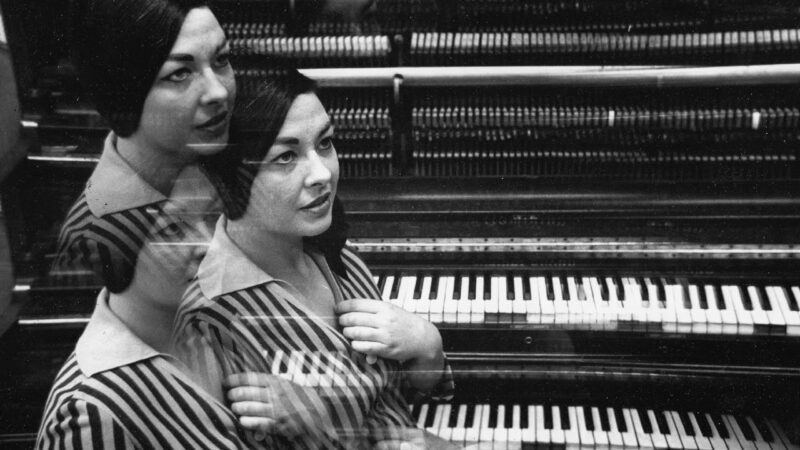
Written by Elma Miller and Gayle Young
How do we remember our pioneering women composers? Do we perform their music, write about their music, admire their perseverance? Norma Beecroft, composing a generation after pioneers Jean Coulthard, Violet Archer and Barbara Pentland, was an inspiring role model for young women composers in the seventies and beyond. Her many accomplishments are described online, and after her death last fall several in-depth obituaries outlined details of her music and her career. (We’ve included some links below.)
We’ve chosen to present our personal perspectives here, to position Norma’s accomplishments in the context of our own experiences. Most composers work alone when writing music, and ideally we also work within communities. For us, the founding of the ACWC presented an opportunity to get to know other women in music and build a stronger sense of collegiality. We (Elma and Gayle) studied music at “rival” Toronto universities (U of T and York) and met when we represented our respective institutions at a conference/festival in Montreal in 1977. That was a milestone: women composers representing their respective universities had up to then rarely been heard. In the 80s, prior to email list serves, when most meetings were held in rooms with chairs, we appreciated opportunities to get to know other woman composers personally.
The situation then facing women composers when they enrolled in music schools was described by Pascale Trudel, a composer of electroacoustic music based in Montreal. She recalled that there were seldom more than two women in university music classes, and it was normal to include only music created by men in class discussions and demonstrations. In music and electronics stores getting the attention of a salesman was sometimes virtually impossible for a woman. In a later conversation with Elma, Trudel described hearing music by Marcelle Deschenes for the first time in a class that took place on International Women’s Day. Trudel wondered why only on that special day, why not include women composers on programs throughout the year? The Women’s Day tradition began in 1911 during suffrage protests in Europe and was formally recognized in 1977, the year we graduated.
We both heard music by Deschenes and Ann Southam (who hosted early ACWC meetings at her home) but knew little about the music of other female composers. Elma hosted a meeting of the ACWC in Hamilton where reel-to-reel magnetic tape recordings were played and as we listened we came to know one another better. Some brought scores to look at, some spoke about their musical processes. It was a great opportunity to realize that ‘we’ were not alone. There was speculation that perhaps the silence that surrounded women’s music can be attributed to the low number of women in academic music institutions at the time.
A generation earlier, when Norma had decided to hone her craft and learn the necessary skills, she chose to study composition privately with John Weinzweig. A solid foundation was important and it is apparent that Norma got a good start. She was the first freelancer, going on the road outside the academic umbrella. It was hard for her then, as she faced financial barriers. The small number of women in music may have felt discouraging, and perhaps lonely, to others, but Norma persisted.
The advantages of a university position include travel support to give papers, colleagues willing to perform your music, memberships in professional organizations, subscriptions to professional journals, and the status of being a professor of composition — not to be underestimated.
Distinctions between freelancers and academic composers have blurred over the years. In Norma’s world there was a greater distinction between academic and freelance composers. It was harder then for freelance composers to gain financial support for travel, to pay registration and accommodation costs for conferences, and this meant it was harder to meet international colleagues, harder to form collegial connections, harder to bring attention to one’s accomplishments. Over years of success, a cumulative process would lead to broadening international recognition, but the challenges of accomplishing this as a freelance new music composer were significant. Perhaps the history of music that includes acknowledgement of the vital roles women have played, including composition outside academic circles, has yet to be written.
Norma begin studying composition with John Weinzweig in 1952, and in 1954 began working as a scriptwriter for CBC radio. Aaron Copland invited her to participate in the Tanglewood Festival at the Berkshire Music Centre in 1958, an exciting step into the international world of composition. Her horizons opened further when Lukas Foss introduced her to 12-tone music. She successfully premiered a new composition during the Tanglewood festival, and impressed several well-known conductors, composers and musicians, meeting Zubin Mehta and Claudio Abbado. She was encouraged that summer to continue her studies in Europe, which she did between 1959 and 1962. It must have been an exhilarating experience to travel alone to Italy to study at the Cecilia Academy with the renowned composer Goffredo Petrassi. This was the new age of expression, influenced by technological advances, and when the five-month semester was over Norma went to Darmstadt to study with Bruno Maderna, again successfully premiering adventurous compositions to public acclaim.
After returning to Toronto she completed several commissions for new compositions, some of them ambitious large-scale works. But Toronto could not provide the benefits she had experienced when she studied in Europe. She retuned to her previous employment at CBC Radio and TV, this time producing and recording concerts for radio and television, and she continued studying composition with John Weinzweig.
In 1967 Barbara Frum, interviewing Beecroft for The Globe and Mail, asked about Canadian Women composers, and Beecroft responded: “It’s a fairly recent, fairly rough field for a woman to be in.” That year Canadian composers and artists were given unusual public recognition due to Canada’s centennial.
As composition students in the seventies, we felt that Norma was providing an encouraging role model as a successful composer, but in today’s context a dark side of the story has come to our attention. Her responsibility producing and recording concerts for CBC broadcast was to ‘help’ other composers by broadcasting their music. This was significantly different from the roles of academic composers who received support to promote their own music, and from the roles of artistic directors who attended international music events to check out the talent, then inviting chosen composers to present their music Canada, then often receiving return invitations to present their own music.
It is significant that all Norma’s efforts were made on behalf of other composers: the inclusion of her own music in CBC broadcasts would have been declared a conflict of interest. Concert production was a ‘helping’ role. The heady acclaim given her ambitious compositional practice in the fifties began to wane a few years after her return to Canada.
She eventually moved out of Toronto, back to her home town where she grew flowering plants to sell at the local farmers market, and attended fewer music events. In her last years, working closely with Brian Cherney, she began to formalize her own legacy, to create a public record of her service to Canadian music in general, her own compositions, and the barriers she had experienced. She set the stage for the publication of six months of romantic correspondence between herself and Harry Somers between fall 1959 and winter 1960, letters sent while she was studying in Italy. A month after Beecroft died Cherney’s book Between Composers: The Letters of Norma Beecroft and Harry Somers was published.
Described on the dust jacket as “an intimate window into how difficult it was for a woman to set out on a path of becoming a composer in the mid-twentieth century” the letters capture the “passionate and tumultuous relationship.” The romance had begun in 1955 and ended during Norma’s final days in Italy when Somers attempted to convince her to abandon her career as a composer. In his introduction Cherney pointed out that Beecroft had at that time already developed a sophisticated compositional language and had set the stage for a confident and independent career as a composer.
Norma’s story fits our experience. We both work outside institutional contexts, and have accepted responsibilities to support the music of others, believing that we were acting on behalf of a sometimes-vague sense of ‘community.’ We share a sense of the importance of collective creation and experience in music. Norma gave so much to music organizations over the years, sometimes at the expense of her own compositional output. The “me-too” element came later when she stepped back from concert administration and returned to composition.
Her music demonstrates independent thinking, flexibility in the use of graphic notation and extended notational techniques, the careful use of instruments and electronics, both as support material and as independent sound. In her early years electronic sound was not always accepted; critics described tape accompaniment as “tricks,” yet Norma pushed the boundaries by including both electronic music and acoustic instruments simultaneously.
Side-bars: Some Compositions by Norma Beecroft
Rasas (from the Sanskrit) was completed in 1969, a decisive year for Norma as she had married in 1968 and was now ready to devote all her time to composition. No two performances of Rasas are alike as the flute and piano offer lyric elements as the other instruments provide texture. Peter Such describes it: “Violins wail, gongs sound and above these the flute draws out lines of long, sustained notes – difficult to play – while the piano adds its own peculiar, percussive sequences.” Technology was slowly making progress in practical applications for composition.
The Living Flame of Love, a choral work for Waterloo Lutheran University was recorded in 1972 by the Festival Singers under Elmer Iseler. It contrasts the austere tonality of early Spanish church music with text from St. John of the Cross, maintaining Norma’s complex style while remaining suitable for performance by the limitations of a student choir.
Collage’76 was commissioned by New Music Concerts in 1975 with the assistance of the Ontario Arts Council. Notes from the LP recording describe the work: As the title may imply, Collage ’76 is basically the superimposition of two of Norma Beecroft’s works, Piece for Bob and 11 and 7 for 5 +. To this combination is added fragments from other of the composer’s instrumental works of the past decade. Although the players are divided into three groups, the flute plays a predominant and unifying role. The tape material includes electronically altered instrumental sounds and computer generated sequences, the latter using the POD 6 program of Barry Truax, produced at the Institute for Sonology in Utrecht, and “Outperform”, a computer synthesis program written by David Jaeger operating at the University of Toronto Computer Centre.
Consequences for 5 was written in 1977 for pianist Karen Kieser, piano, accompanied by Michael Malone, trumpet, George Stimpson, horn, John Dowden, trombone and the Canadian Electronic Ensemble (Larry Lake, David Jaeger, David Grimes and James Montgomery) The piece was written specifically for pianist Karen Kieser and the four members of the CEE.
References online
• The Canadian Music Centre: https://cmccanada.org/norma-beecroft-1934-2024/
• The Canadian Encyclopedia: https://www.thecanadianencyclopedia.ca/en/article/norma-beecroft-emc
• Wikipedia: https://en.wikipedia.org/wiki/Norma_Beecroft
• Pascale Trudel: An Electronic Studio of One’s Own